The self-audit takes about five minutes. No email required to see your result.The self-audit takes about five minutes.
Valentia
Perimenopause

Why is my hair thinning in perimenopause?

CommonTwo kindsSix months

A parting wider than it was, or handfuls in the brush. Two different things that look alike, only one grows back on its own, and both want the same two blood tests first.

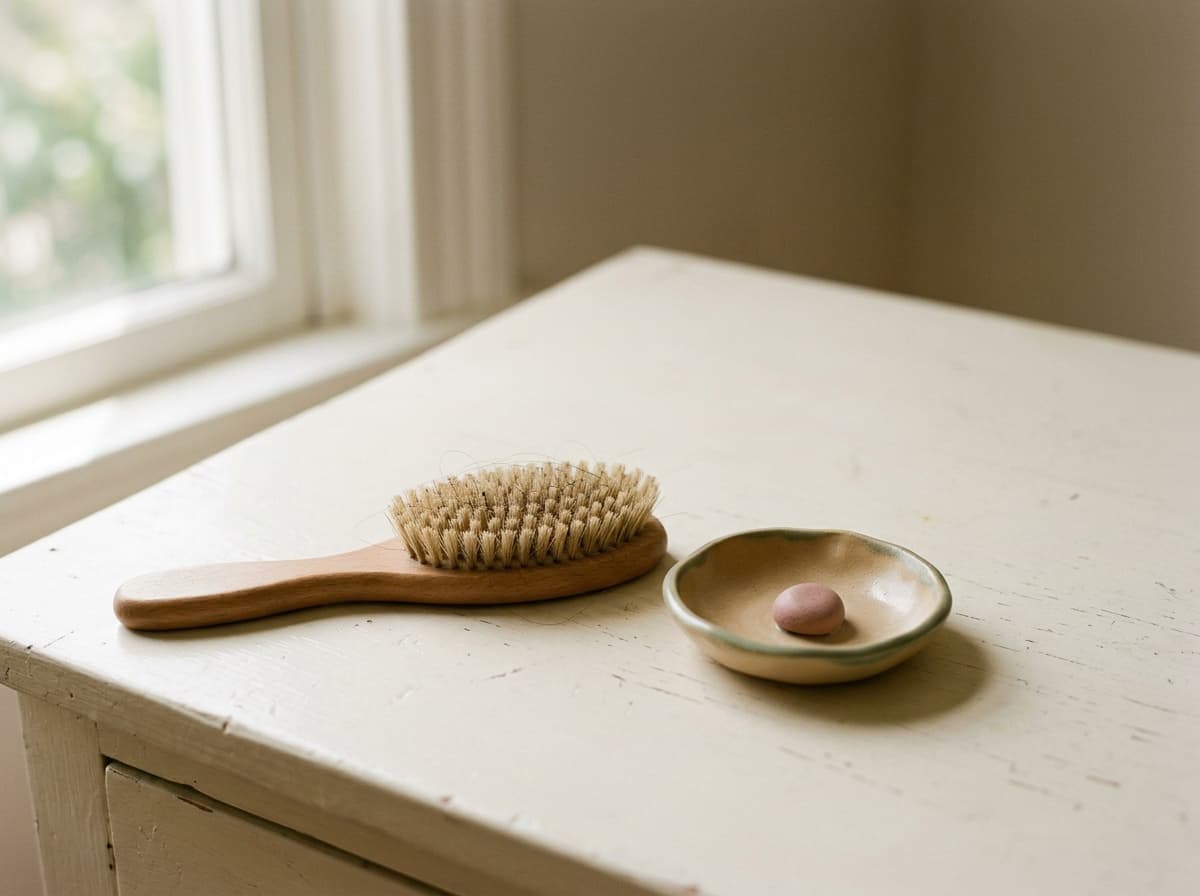
A hairbrush on a bone dresser
Tonight, in three steps
  1. Look at the parting in daylight: wider than a year ago, or the same width with more in the brush
  2. Book ferritin and thyroid function, the two blood tests that change the answer
  3. Stop the tight ponytail and the hot tools until you know which kind this is
Jump to what I would do first

26%

of post-menopausal women in a population study reported diffuse scalp hair loss, the most common form

Ali and Wojnarowska, Br J Dermatol, 2011

18.5

ng/mL lower ferritin, on average, in women with non-scarring hair loss than in women without it, across 36 studies

Treister-Goltzman et al., Skin Appendage Disord, 2022

6 months

is the minimum before clinical improvement is typically seen on treatment for pattern hair loss, per Australian prescribing guidance

Iyengar and Li, Aust Prescr, 2025
The short answer

Hair thins in the transition for two different reasons that look the same in the brush, and only one of them grows back on its own.

Hair thins in perimenopause because oestrogen, which keeps follicles growing longer, falls away. Two things follow: female pattern hair loss, a parting widening slowly and more common after menopause, and shedding, which comes in waves two to four months after a trigger and usually recovers. Low iron and a slow thyroid make both worse, and both are a blood test.

Hair grows in cycles. In a healthy scalp about 85% of follicles are in the growing phase and about 15% are resting, and a follicle grows for around four years before resting for about four months and shedding that hair as a new one pushes through. Oestrogen extends the growing phase, which is why hair sheds after childbirth, a classic trigger for the wave of loss described below. The transition removes that extension, so more follicles rest at once, and a New Zealand clinical reference says female pattern hair loss is more common after the menopause, suggesting oestrogens are stimulatory for hair growth.

There are two conditions here and they want different answers. Female pattern hair loss is diffuse thinning over the top of the scalp, a parting that widens over years, with the frontal hairline usually kept. It is not the male pattern, it is very uncommon for women to bald that way without excess androgens, and the same reference says it is not clear androgens play a role at all: most women with it have normal levels in their blood. Telogen effluvium is the other one. A shock to the system, a fever, a surgery, a crash diet, a bereavement, can push as many as 70% of growing follicles into rest at once, and the fall arrives two to four months later, in handfuls, and can take up to half the scalp hair before it recovers. Chronic shedding with no clear trigger tends to present in otherwise healthy women between 30 and 60, which is this decade, and it is often confused with pattern loss.

In a population study of post-menopausal women, diffuse scalp hair loss was the most common form, reported by 26%, with frontal loss at 9%. The study found two patterns: diffuse thinning that travelled with body hair loss and older age, and frontal loss that travelled with more facial hair at a relatively younger age. That second pattern is the androgen story the facial hair page tells, and if you have both the chin and the hairline, they are one change.

Then the two things underneath that make either worse and that a blood test finds. Across 36 studies and over 10,000 women, those with non-scarring hair loss had ferritin on average 18.5 ng/mL lower than women without it, and 21% had ferritin at or below the 10 to 15 range. Periods often get heavier in the transition, and iron leaves with them. An underactive thyroid thins hair alongside tiredness and feeling cold. Neither is the whole story and both are cheap to rule in or out, which is why they are the first move and not the last.

The usual causes
oestrogen's growing-phase support falling awaya shed two to four months after a shocklow ferritin from heavier periodsan underactive thyroidtight styles and heat on finer hairthe androgen pattern, where the hairline goes with the chin
What you need to know

TLDR, if you are in a rush.

Yes, hair thinning is a symptom of perimenopause. Oestrogen keeps follicles growing longer, and as it falls more of them rest at once. Female pattern hair loss is more common after menopause for that reason.

There are two kinds and they answer differently. Pattern loss is a parting widening over years; it does not reverse on its own but it responds to treatment. Shedding comes in waves two to four months after a trigger and usually recovers.

Two blood tests change the answer: ferritin and thyroid function. Women with hair loss have measurably lower ferritin across 36 studies, and heavier periods in the transition are why.

Treatment for pattern loss exists and works slowly: minoxidil, topical or oral, and antiandrogens such as spironolactone, with a minimum of six months before improvement is typically seen. Supplements have varying evidence and are not the treatment.

See a GP if the loss is patchy, if the scalp is sore, scaly or scarred, if it arrived suddenly and heavily, or if it comes with a deepening voice, acne and coarse facial hair together.

Before tonight

Four things to settle before you try anything.

01

Which kind

Stand in daylight and look at the parting. Wider than it was a year ago, hair finer on top than at the sides, the front line kept: that is pattern loss. Same parting, but handfuls in the brush and the shower for a few weeks, often a few months after a hard time: that is shedding. The two want different answers and this is the ten-minute check that decides which page of advice applies.

02

The blood tests

Ferritin and thyroid function. Not a hair vitamin, not a scalp serum. Women with hair loss have measurably lower ferritin, and a slow thyroid thins hair alongside everything else it does. Ask for the ferritin number itself, because the bottom of the range is not the same as enough for a scalp.

03

The count

Hair loss is slow and the mirror lies. Photograph the parting and the crown from above in daylight on day one. Count what is in the brush for a week if you want a number. Anything judged inside three months is being judged by a mood.

04

The handling

Finer hair breaks, and breakage looks like loss. Tight ponytails, hot tools daily, brushing wet hair hard and heavy extensions all cost hair you cannot spare. This changes nothing at the follicle and it stops the losses on top.

Searching moments

When women go looking for this.

My parting is wider than it was

That is pattern loss, and it is the version most women in this decade have. It does not reverse by itself, it is not caused by anything you did, and it responds to treatment that exists and is prescribable. Six months before you judge it.

It is coming out in handfuls

That is shedding, and it is frightening because of the volume. Look back two to four months for a trigger: illness, surgery, a diet, grief, a new medicine. Shedding usually recovers on its own once the trigger has passed, and low ferritin is the thing that stops it recovering.

It is thinning at the front

Frontal loss is the less common pattern and it travelled, in a population study, with more facial hair at a younger age. If you have the chin hairs too, this is the androgen story and the facial hair page is its sibling.

The shampoo and conditioner did nothing

Nothing in a shampoo or conditioner reaches the follicle in the way a treatment does. A gentle wash is worth having so that finer hair is not stripped and broken, and that is the whole of what it can do.

Common misconceptions

What women get wrong about it.

Assumption

It must be stress.

Reality

Stress is one trigger for shedding, and the shed arrives months later, not during the stress. Pattern loss is not stress at all; it is follicles resting sooner because the hormone that kept them growing has fallen.

What to do instead

Work out which kind you have from the parting and the timing before assigning a cause. The two answer differently.

Assumption

A hair vitamin or biotin will fix it.

Reality

Australian prescribing guidance says supplements have varying levels of evidence, and none of them is the treatment for pattern loss. The same guidance says iron deficiency and thyroid dysfunction must be treated before hair loss treatment starts, which is the opposite order from buying a vitamin first.

What to do instead

Test ferritin and thyroid. Treat low iron if it is low. Then, if the pattern is pattern loss, ask about the treatments that have evidence.

Assumption

It is my androgens.

Reality

For the frontal pattern with chin hairs, partly. For the common diffuse pattern, a clinical reference says it is not clear androgens play a role and that most women with it have normal androgen levels. The clearer signal is oestrogen falling.

What to do instead

Do not chase androgen blood tests for diffuse thinning. Ask for ferritin and thyroid, and treat what the parting shows.

Assumption

Cutting it short makes it grow thicker.

Reality

Cutting changes nothing at the follicle. Shorter hair can look fuller because there is less weight pulling it flat and fewer split ends, which is worth having, but it is a styling result rather than growth.

What to do instead

Cut it if it suits you. Treat the follicle separately.

Assumption

If it has not improved in a month the treatment failed.

Reality

The hair cycle is measured in months. Australian guidance puts the minimum before clinical improvement at six months, and Australian guidance notes many patients report reactive shedding on minoxidil for two to three months before it settles.

What to do instead

Photograph day one, and judge at six months, not six weeks. Expect the early shed and do not stop on it.

Assumption

Hormone therapy will fix my hair.

Reality

Hormone therapy is prescribed for symptoms overall and the evidence on scalp hair specifically is not what decides it. Pattern loss has its own treatments, which work whether or not a woman is on hormone therapy.

What to do instead

Raise the hair at a review as its own item. The answer may be a hair treatment alongside, not instead.

Assumption

Washing it less will save hair.

Reality

The hairs that come out in the shower were already shed. Washing less lets them accumulate and come out in a bigger handful, which looks worse and changes nothing.

What to do instead

Wash as often as suits your scalp, gently, and stop counting the shower hairs as new losses.

What I would do first

In this order, for this reason.

Four moves, and the first two decide whether the third is needed at all.

Decide which kind from the parting and the timing

Pattern loss is a parting widening over a year or more, hair finer on top, hairline kept. Shedding is a wave of loss over weeks, two to four months after an illness, a surgery, a crash diet, a bereavement or a new medicine, with the parting unchanged. Both at once is common. Photograph the parting and crown from above in daylight today.

Ten minutes, and it decides the rest

Test ferritin and thyroid function

Women with non-scarring hair loss have measurably lower ferritin across 36 studies, and heavier periods in the transition are the usual reason. An underactive thyroid thins hair alongside fatigue and feeling cold. Ask for the ferritin number, and if it is low, treat it; shedding does not recover well on empty iron stores.

Results in a week; iron rechecked at three months

Change the handling while you wait

Loose styles, heat tools no more than a couple of times a week, no brushing wet hair hard, a gentle wash as often as your scalp likes. Finer hair breaks, and breakage reads as loss. None of this reaches the follicle and all of it stops the losses on top.

Breakage settles within a few weeks

For pattern loss, ask about treatment that has evidence

Australian prescribing guidance names minoxidil, topical or oral, and antiandrogens such as spironolactone as the pharmacological treatments for female pattern hair loss, often in combination, with a minimum of six months before improvement is typically seen. Minoxidil is available over the counter; the rest is a prescription conversation. Many patients report reactive shedding for the first two to three months on minoxidil, and it generally settles; do not stop on it.

Six months minimum before you judge it
This month

The habits that change the baseline.

The moves above find the cause and treat it. These protect what you have.

A photograph every three months, same light, same angle

The only honest way to know whether anything is working, because the mirror reports mood rather than density.

Protein at every meal

Hair is protein and a crash diet is a classic trigger for a shed two to four months later. Steady intake is cheap insurance.

Ferritin rechecked after three months on iron

If iron was started, it needs a recheck. Taking it forever is not the plan and neither is stopping early.

Loose at night

A silk or satin pillowcase and a loose plait or nothing at all. Friction on fine hair overnight is a small daily tax.

Heat no more than twice a week

And a heat protectant when you do. This is the breakage half of thinning and it is entirely within your control.

Treatment continued, if it works

Pattern loss treatment maintains rather than cures. Stopping returns the follicles to where they were. Decide that going in.

Research notes

Source-backed signals for this page.

Each line is a specific figure or finding, with where it came from. Nothing on this page is guessed.

In a population-based study of post-menopausal women, diffuse generalised scalp hair loss was the most common form, reported by 26%, and frontal hair loss by 9%.

Ali and Wojnarowska, Br J Dermatol, 2011

The same study found two patterns: diffuse loss correlated with body hair loss and increasing age, and frontal loss associated with higher facial hair scores at a relatively younger age.

Ali and Wojnarowska, Br J Dermatol, 2011

A New Zealand clinical reference describes female pattern hair loss as diffuse thinning on the scalp, says it is not clear whether androgens play a role and that most women with it have normal androgen levels, and notes it is more common after the menopause, suggesting oestrogens are stimulatory for hair growth.

DermNet, Female pattern hair loss

In a healthy scalp about 85% of follicles are growing and 15% resting; a shock to the system can push as many as 70% into rest, the fall is noticed two to four months after the trigger, and it can affect up to half the scalp hair. Chronic shedding with no clear cause tends to present in otherwise healthy women aged 30 to 60.

DermNet, Telogen effluvium

Across 36 studies and 10,029 participants, women with non-scarring hair loss had ferritin on average 18.5 ng/mL lower than women without, and 21% had ferritin at or below the 10 to 15 range.

Treister-Goltzman et al., Skin Appendage Disord, 2022

Australian prescribing guidance names minoxidil, topical and oral, and antiandrogens such as spironolactone as the pharmacological treatments for female pattern hair loss, often combined, with clinical improvement typically requiring a minimum of six months, and says supplements have varying levels of evidence.

Iyengar and Li, Aust Prescr, 2025

An underactive thyroid presents with tiredness, feeling cold, weight gain, dry skin and thinning hair, and is separated from the transition by a blood test.

healthdirect, Hypothyroidism

The studies

The research behind the advice.

Not testimonials. The studies that give the moves above their standing, with what was tested and what was found.

01 · British Journal of Dermatology 164(3), population study, 2011

How common, and which pattern

What was tested
How scalp, facial and body hair actually change after the menopause, by self-report in a population sample.
How
A cross-sectional population-based study of post-menopausal women reporting hair change by site and pattern.
What was found
Diffuse scalp loss in 26% and frontal loss in 9%, with the diffuse pattern travelling with body hair loss and age, and the frontal pattern with more facial hair at a younger age.
What it means for you
One in four is common enough to be ordinary, and the two patterns matter: the frontal one is the androgen story, the diffuse one mostly is not.
View source

02 · Skin Appendage Disorders 8(2), systematic review and meta-analysis, 2022

The iron question, answered across 36 studies

What was tested
Whether women with non-scarring hair loss have lower ferritin than women without, and how common deficiency is among them.
How
A systematic review of 36 studies with 10,029 participants, comparing ferritin between women with and without non-scarring alopecia using random-effects meta-analysis.
What was found
Ferritin was on average 18.5 ng/mL lower in women with hair loss, and 21% had ferritin at or below the 10 to 15 range. The authors conclude women with hair loss can benefit from higher ferritin.
What it means for you
This is the reason ferritin is a first move and not an afterthought, and the reason the number matters more than the tick. The bottom of the reference range is not enough for a scalp.
View source

03 · Australian Prescriber 48(3), clinical review, 2025

What actually treats it, in Australia

What was tested
The current management of male and female pattern hair loss for Australian prescribers.
How
A Therapeutic Guidelines review of diagnosis, differentiation from other hair loss, and pharmacological treatment.
What was found
For female pattern hair loss, minoxidil topical and oral and antiandrogens such as spironolactone, commonly combined, with a minimum of six months before clinical improvement; supplements with varying levels of evidence.
What it means for you
Treatment exists, it is prescribable here, it takes six months, and the supplement aisle is not it. That is the whole practical answer in one paragraph.
View source
Comparison

Pattern loss, shedding, or something to test for?

Three things that all look like more hair in the brush, and the questions that separate them. Most women in this decade have some of the first two.

Pattern lossSheddingIron or thyroid
What you seeA parting wider than a year ago, finer on top than at the sides, hairline kept.Handfuls in the brush and shower for weeks, parting unchanged, all over rather than on top.Either of the other two, plus tiredness, feeling cold, heavy periods or brittle nails.
When it startedGradually, over a year or more, in the transition.Two to four months after an illness, surgery, crash diet, bereavement or new medicine.Alongside heavier periods, or with the cold-and-tired picture.
Does it grow backNot on its own. It responds to treatment, which maintains rather than cures.Usually yes, once the trigger has passed, over six to twelve months. Low iron is what stops it.Yes, when the deficiency or the thyroid is treated.
The first moveFerritin and thyroid, then a conversation about minoxidil and antiandrogens.Find the trigger, test ferritin, protect the hair from breakage, and wait.Treat it. The hair follows the blood test, slowly.
When it is a GP questionIf it is with a deepening voice, acne and coarse facial hair together, which is a hormonal workup.If it has run more than six months with no recovery, or the scalp is sore or scaly.Always, because this is a treatment rather than a routine.
Fit check

Who this page is for, and when to see a GP instead.

This will help if
  • your parting is wider than it was, or there is noticeably more in the brush than a year ago
  • you are somewhere in the transition and other things have shifted too
  • you want to know whether it will grow back, and the honest answer is that it depends which kind
  • you have been sold a vitamin and want to know what actually has evidence
See a GP instead when
  • the loss is patchy, in coins or bald spots rather than diffuse, which is a different condition
  • the scalp is sore, itchy, scaly, red or scarred where the hair has gone
  • it arrived suddenly and heavily, or shedding has run more than six months without recovering
  • it comes with a deepening voice, new acne and coarse facial hair together: ask for a hormonal workup
  • it comes with tiredness, feeling cold, weight gain or heavy periods: ask for ferritin and thyroid function
  • you are on a new medicine that started in the same months, and do not stop it yourself
By situation

The same rules, applied to your case.

A widening parting, nothing elseThe common version, arriving slowly.

Pattern loss. It is ordinary in this decade, it is not caused by anything you did, and a clinical reference says most women with it have normal androgen levels, so do not chase those tests. Photograph the parting today.

Then

Ferritin and thyroid first, then the treatment conversation, then six months.

Handfuls, three months after a hard patchAn illness, a surgery, a diet, a loss.

Shedding, and the timing is the diagnosis: the fall arrives two to four months after the trigger, once resting follicles release. It can take up to half the scalp hair and it usually recovers over six to twelve months.

Then

Test ferritin, because empty iron stores are what stop a shed recovering. Protect the hair from breakage while it grows back.

Thinning at the front, with chin hairsThe hairline and the chin arriving together.

The frontal pattern travelled, in a population study, with more facial hair at a younger age. The same study found body hair loss, on the legs and at other androgen-sensitive sites, correlated with age and travelled with the diffuse scalp pattern, so thinning hair on the legs is the same story arriving lower down. That is one hormonal change at two follicles, and it is the androgen story rather than the oestrogen one.

Then

The facial hair page is the sibling of this one. If the growth is sudden and heavy or the voice has deepened, that is a hormonal workup.

Heavy periods and thinning hairBoth got worse together.

That pair is iron until a test says otherwise. Women with hair loss have measurably lower ferritin across 36 studies, and heavier periods in the transition are the usual reason it fell.

Then

Ask for the ferritin number. If it is low, treat it and recheck at three months. Hair follows the blood test slowly.

On menopausal hormone therapy (MHT, or HRT), and still thinningPrescribed for the flushes, wondering about the hair.

Hormone therapy is given for symptoms overall. Pattern loss has its own treatments, prescribable in Australia, that work whether or not a woman is on hormone therapy, and shedding still wants its ferritin checked.

Then

Raise the hair at a review as its own item, and ask about minoxidil and antiandrogens alongside.

The seven-day plan

One change a day, in the order they matter.

A week to decide which kind and to get the tests in. Then six months of not judging it by the mirror, which is the hard part.

Day one

Photograph the parting and the crown from above in daylight. Note whether the parting has widened or the loss is in handfuls.

Day two

Look back two to four months for a trigger: illness, surgery, a diet, grief, a new medicine. Write it down whether or not you find one.

Day three

Ring for ferritin and thyroid function. Ask for the ferritin number, not just whether it is in range.

Day four

Take the ponytail out and put the hot tools away for the fortnight. Loose styles, a silk pillowcase, no hard brushing when wet.

Day five

Protein at every meal from today. A crash diet is a shed trigger, and hair is protein.

Day six

Results back: low ferritin is treated and rechecked at three months. A slow thyroid is a GP conversation this week.

Day seven

If the parting has widened, book the conversation about minoxidil and antiandrogens. Set a reminder for the second photograph in three months and the verdict at six.

Questions

What women ask before they try this.

Yes. Oestrogen keeps hair follicles in their growing phase longer, and as it falls more of them rest at once. A clinical reference says female pattern hair loss is more common after the menopause for that reason, and in a population study 26% of post-menopausal women reported diffuse scalp hair loss. Low iron from heavier periods and a slow thyroid make it worse, and both are a blood test.

Two reasons that look alike. Pattern loss: the parting widens over a year or more as follicles rest sooner without oestrogen's support, and most women with it have normal androgen levels. Shedding: a wave of loss two to four months after an illness, a surgery, a crash diet or a bereavement, when up to 70% of growing follicles rest at once. Underneath either, ferritin and thyroid decide how well the hair recovers.

It depends which kind, and this is the honest answer most pages skip. Shedding usually grows back over six to twelve months once the trigger has passed, and low iron is what stops it. Pattern loss does not reverse on its own, but it responds to treatment, which maintains what you have and thickens what is fine. Both recover better when ferritin and thyroid are right.

Shedding runs its course over months: the fall starts two to four months after the trigger and recovery takes six to twelve. Pattern loss is gradual and ongoing, which is why treatment is maintenance rather than a course. Australian prescribing guidance puts the minimum before improvement on treatment at six months. Judge nothing about hair inside three months.

Decide which kind from the parting and the timing. Test ferritin and thyroid function and treat what is low. Protect the hair you have from breakage: loose styles, less heat, no hard brushing wet. For pattern loss, ask about minoxidil, topical or oral, and antiandrogens such as spironolactone, which Australian guidance names as the treatments. Give it six months and photograph day one.

Iron does, where ferritin is low, and women with hair loss have measurably lower ferritin across 36 studies. Beyond that, Australian prescribing guidance says supplements have varying levels of evidence and none is the treatment for pattern loss, and that iron deficiency and thyroid dysfunction must be treated before hair loss treatment starts. Test first, then treat what is actually low.

For pattern loss, it is one of the two treatments Australian guidance names, topical or oral, often combined with an antiandrogen. It takes a minimum of six months to show improvement, many patients report reactive shedding for the first two to three months before it settles, and it may need to be continued long term, so stopping returns the follicles to where they were. Topical minoxidil is available over the counter.

It could be, and the test is easy. An underactive thyroid thins hair alongside tiredness, feeling cold, weight gain and dry skin, which is a picture women readily attribute to the transition instead. Thyroid function is one blood test and it belongs in the first week, not after a year of shampoos. If it is the thyroid, treatment works and the hair follows, slowly.

Frontal loss is the less common pattern, at 9% in a population study against 26% for diffuse loss, and it travelled with more facial hair at a younger age. If you have chin hairs too, this is the androgen story rather than the oestrogen one, and the facial hair page is its sibling. Sudden heavy growth with a deepening voice is a hormonal workup.

If the loss is patchy rather than diffuse, if the scalp is sore, scaly or scarred, if it arrived suddenly and heavily, or if shedding has run more than six months without recovering. Also if it comes with a deepening voice, acne and coarse facial hair together, or with tiredness, feeling cold and heavy periods. Ask for ferritin and thyroid function either way.

Keep reading

Related symptoms, and the articles that go with this one.

References

Sources used on this page.

Every figure and finding above traces to one of these.

Physiological changes in scalp, facial and body hair after the menopause: a cross-sectional population-based study of subjective changes

Ali and Wojnarowska, British Journal of Dermatology 164(3), 2011.

Diffuse scalp hair loss in 26% and frontal loss in 9% of post-menopausal women, and the two patterns: diffuse loss with body hair loss and age, frontal loss with higher facial hair scores at a younger age.

Female pattern hair loss

DermNet, New Zealand, accessed September 2026.

Female pattern hair loss as diffuse thinning, its distinction from the male pattern, the unclear role of androgens and normal androgen levels in most women with it, its greater frequency after the menopause suggesting oestrogens are stimulatory for hair growth, and its confusion with chronic telogen effluvium.

Telogen effluvium

DermNet, New Zealand, accessed September 2026.

The 85% growing and 15% resting ratio, the four-year growing phase and four-month rest, up to 70% of follicles precipitated into rest by a shock, the fall noticed two to four months after the trigger, up to 50% of scalp hair affected, and chronic shedding presenting in otherwise healthy women aged 30 to 60.

Iron deficiency and nonscarring alopecia in women: systematic review and meta-analysis

Treister-Goltzman et al., Skin Appendage Disorders 8(2), 2022.

The 36 studies and 10,029 participants, ferritin 18.5 ng/mL lower on average in women with non-scarring hair loss, 21% with ferritin at or below the 10 to 15 range, and the conclusion that women with hair loss can benefit from higher ferritin.

Male and female pattern hair loss

Iyengar and Li, Australian Prescriber 48(3), 2025.

Minoxidil topical and oral and antiandrogens such as spironolactone as the pharmacological treatments for female pattern hair loss, combination therapy being common, the minimum of six months before clinical improvement, reactive shedding for two to three months on minoxidil that generally settles, treatment that may need to continue long term, iron deficiency and thyroid dysfunction to be treated before hair loss treatment starts, and supplements having varying levels of evidence.

Hypothyroidism (underactive thyroid)

healthdirect, accessed September 2026.

The symptom picture of an underactive thyroid, including thinning hair alongside tiredness, feeling cold and weight gain.

Written by Davina Hearne, 11 September 2026.

Davina Hearne qualified in 2012 at Wellpark College of Natural Therapies in New Zealand, with three NZQA Level 6 diplomas taken together over three years: Naturopathy, Herbal Medicine and Nutrition.

Davina Hearne is a New Zealand qualified naturopath, herbalist and nutritionist. She is not a medical doctor. This is health education from a qualified non-physician practitioner. It is not medical advice and does not establish a practitioner relationship.

Start tonight

Decide which kind, test the two things, then give it six months.

Pattern loss and shedding look the same in the brush and they are not the same problem. The parting and the timing tell you which you have, ferritin and thyroid tell you what is underneath, and the treatment for pattern loss exists and is prescribable here. Photograph the parting today, because the mirror will not tell you the truth about a change this slow in either direction.

Free, by email

The 3am wake, five days by email.

Whatever brought you here, sleep is where Davina starts with everyone. One short email a day, beginning with why you wake and what to change first.

Your bag

Your bag is empty. The Serum Set is the place most women start.