Why do I get hot flushes and run warm in perimenopause?
It starts as warm nights, then becomes a flush that arrives without warning, day or night. The thermostat that held for decades has narrowed.
Written by Davina Hearne, Naturopath (Diploma, NZ). Published 6 September 2026.
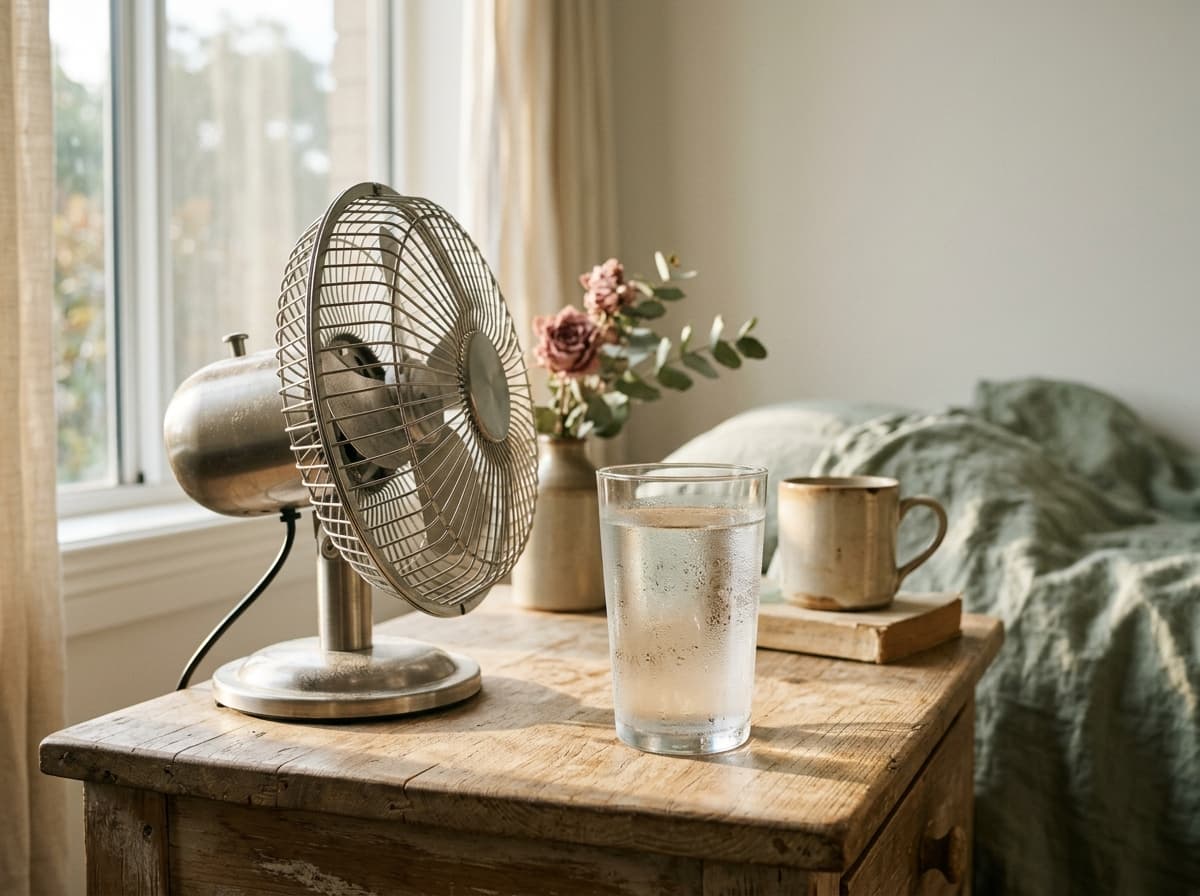
- Bedroom at 16 to 19 degrees, cotton against the skin, a glass of water by the bed
- No alcohol tonight, and nothing hot to drink after dinner
- Count them for a week: when, how long, what came before. The pattern is the evidence
About 3 in 4
women experience hot flushes or night sweats around the time of menopause
Jean Hailes for Women's Health7.4 years
the median duration of frequent flushes in the SWAN cohort, longer for women whose flushes began early
Avis et al., JAMA Internal Medicine, 20150.4 degrees
the band of core temperature the body tolerates before it acts, which narrows to almost nothing in women with flushes
Freedman and Krell, Am J Obstet Gynecol, 1999A hot flush is the brain's thermostat firing at a change that used to pass unnoticed, and the triggers are more controllable than the hormone.
A hot flush is the brain's thermostat misfiring. Falling oestrogen releases a cluster of hypothalamic neurons from restraint, and the band of temperature the body tolerates before it acts narrows to almost nothing. A small rise that once passed unnoticed now triggers the full response: heat, sweat, a racing heart. Alcohol, caffeine, a warm room and stress widen the swings.
Core temperature is held inside a narrow band, and inside that band the body is quiet. When it drifts above the band, the body acts: blood vessels at the skin open, sweat starts, heat is shed. In the reproductive years the band is about four tenths of a degree wide. In perimenopause it narrows, in some women to almost nothing, so that a turn under the duvet, a warm room, a cup of tea or a moment of stress crosses the line and the whole heat-shedding response fires at once. The flush is what that feels like from the inside: the sudden heat in the face and chest, the sweat, the racing heart, then often a chill as the heat leaves.
The reason it narrows is a cluster of neurons in the hypothalamus called KNDy neurons, which oestrogen used to restrain. As oestrogen falls and swings, they lose that restraint, enlarge and fire more, signalling into the brain's temperature centre that the thermoneutral band should be smaller than it is. The same cluster is why the newer non-hormonal prescription treatments act on exactly those neurons, and why menopausal hormone therapy, which puts oestrogen's restraint back, is the most effective treatment there is.
At night the same event has a second cost. The arousal that comes with a flush usually starts a moment before the sweat, so the sleep is broken whether or not you feel hot. Alcohol amplifies every part of this: its first breakdown product dilates blood vessels, it raises the night's temperature and cortisol, and it stacks on a thermostat that was already narrow. Women who stop drinking for a fortnight are often surprised by how far the night sweats fall.
TLDR, if you are in a rush.
Flushes are the thermostat's tolerance band narrowing as oestrogen falls. They are common, they usually start as warm nights in the transition, and they last longer than most women are told: a median of several years.
The hormone is not in your control tonight. The triggers are: alcohol, caffeine, hot drinks, a warm room, synthetic bedding and stress each widen the swings, and each is an experiment you can run this week.
First moves: a cooler bedroom, cotton or bamboo against the skin, a fortnight without alcohol, caffeine before noon, five minutes of slow breathing before bed and a count in your notes.
For frequent or disruptive flushes, menopausal hormone therapy is the most effective treatment and a GP conversation worth having with your notes in hand. Cognitive behavioural therapy for flushes has good evidence too. A standardised sage extract has one open-label trial behind it, run by the manufacturer.
See a GP for night sweats that are drenching and come with weight loss, fever or swollen glands, for flushes with palpitations and tremor, or for flushes that arrive with bleeding changes. The thyroid and a few other things cause sweats too.
Four things to settle before you try anything.
Your count
A week of notes: time, roughly how long, what came in the half hour before. Wine, coffee, a hot shower, a hard conversation. Most women find two triggers doing most of the work.
Your night
If the flushes are mostly at night, this page and the 3am wake page share a mechanism. The arousal comes first and the heat a moment after, so fixing the room and the alcohol helps both.
Your baseline
The narrowed band fires from wherever your arousal sits. A body running high on cortisol and caffeine has less room before the threshold than a calm one. Breathing before bed is not decoration; it is buffer.
Your options
Know before the appointment that MHT is the most effective treatment for flushes, that it is a reasonable conversation for most women in the transition, and that non-hormonal prescription options exist for those who cannot or prefer not to. Bring the count.
When women go looking for this.
Woke drenched, sheets soaked
The night sweat, where the room, the bedding and last night's drink are the first three things to look at. If it happens more than once a night most nights, the GP conversation is worth having soon rather than later.
A wave of heat in a meeting
A day flush, often on a hard moment or a hot coffee. The trigger is usually in the previous half hour. The count finds it.
Warm at night, not yet a flush
The earliest form, often a year or more before the full response. A cooler room and no evening alcohol are the whole answer for many women at this stage.
Told to wait it out
The median is years, not months, so waiting is a choice, and it should be an informed one. The fit check below says what belongs with a GP and what you can change this week.
What women get wrong about it.
It will pass in a few months.
In the SWAN cohort the median duration of frequent flushes was over seven years, and longer for women whose flushes started early. Some women have them for a year; many have them for much longer.
Treat it as something to manage, because waiting it out is a plan measured in years. Run the trigger experiments this week and have the GP conversation with a count in hand rather than in a year.
Red wine is the one thing that does not set me off.
Alcohol's first breakdown product dilates blood vessels, raises the night's temperature and cortisol, and red wine adds histamine, which flushes on its own. It is the most reliable trigger on this page.
A fortnight without, with the count in your notes. Most women see the night sweats fall inside a week.
The sweat is what wakes me.
In most night sweats the arousal comes a moment before the heat. The brain is already awake when the flush fires.
Treat the wake and the flush together: the room, the alcohol, the breathing and the 3am wake page's moves.
HRT is dangerous, so it is not an option.
For most women in the transition, menopausal hormone therapy is the most effective treatment for flushes and the risks are small and specific. The frightening headlines came from an older trial in older women on older preparations.
Have the conversation with a GP or a menopause-literate prescriber, with your history and your count. Then decide on your own numbers, because the headlines were about a different group of women.
A cool room is a luxury, not a treatment.
The narrowed band needs a bigger buffer, and a warm bedroom is the single biggest amplifier of night sweats there is. Synthetic bedding traps the heat that tips you over.
16 to 19 degrees, cotton or bamboo bedding and nightwear, a window open or a fan on. A thermometer settles the argument.
Herbal remedies are the safe first step.
Most menopause supplements are underdosed blends with no trial behind them. Black cohosh has mixed evidence and a liver caution. A standardised sage extract has one open-label trial, run by the manufacturer, showing fewer flushes at eight weeks, and that is about the strength of it.
Triggers first, then the GP conversation. If you try sage, use a standardised extract at the trial dose, give it eight weeks and tell the GP you are taking it.
Stress has nothing to do with heat.
Arousal raises the baseline the thermostat fires from. A hard conversation, a rushed morning or a cortisol spike is a common trigger, and the count usually shows it.
Five minutes of slow breathing before bed, and a pause before the meeting. Cognitive behavioural therapy for flushes works partly on this and has good trial evidence.
In this order, for this reason.
In order of how much of the night they give back. The first three are free.
The room, then the bedding
16 to 19 degrees, cooler than most people keep it, with a fan or an open window. Cotton or bamboo sheets and nightwear, not synthetics, and a lighter layer you can push off. A glass of water by the bed. Fix the worst of these tonight.
TonightA fortnight without alcohol
The fortnight is an experiment, and alcohol has earned one, because it dilates the skin's blood vessels, raises the night's temperature and cortisol, and red wine adds histamine on top. Count the flushes through the fortnight. Then, if you keep the glass, keep it early, with food, one glass and never on a night that matters.
Most women see the difference inside a weekCaffeine before noon, hot drinks before dinner
Caffeine narrows the margin and is still circulating at bedtime for many women. A hot drink raises core temperature directly. Both are simple to move earlier in the day.
A week to judgeFive minutes of slow breathing, and the pause before the trigger
In for four or five, out for six or seven. It lowers the baseline the thermostat fires from, so the same event is less likely to cross the line. Cognitive behavioural therapy designed for flushes works on the same principle and has good trial evidence for reducing how much they disrupt.
Two to four weeks for the baseline to shiftThe GP conversation, with the count
Menopausal hormone therapy is the most effective treatment for flushes and night sweats. For most women in the transition without specific risks it is a reasonable option, and the decision belongs with a GP or a menopause-literate prescriber who has your history. Non-hormonal prescription options exist for women who cannot or prefer not to. Bring a week of notes, because it makes the appointment better.
Book it once you have a week of the countIf you want a botanical, a standardised sage extract
One open-label trial, run by the manufacturer, shows fewer flushes at eight weeks on a standardised extract at the trial dose. It is the only botanical for flushes with even that. Tell your GP you are taking it, and skip it in pregnancy or breastfeeding.
Eight weeksThe habits that change the baseline.
The structure that keeps the baseline low.
Layers you can shed in seconds
By day as by night. A cardigan over a cotton top beats a wool jumper you cannot get out of in a meeting.
Cold water within reach
A sip at the first sign shortens some flushes and gives you something to do with the moment.
Move in the day, not at bedtime
Regular exercise reduces flush frequency for many women over months. A hard session inside four hours of bed raises the night's temperature instead.
Steady blood sugar
A crash raises adrenaline, and adrenaline is a trigger. Protein at every meal, carbohydrate never alone.
One wake-up time
The body clock sets the night's temperature curve. A stable clock is a stable curve.
Source-backed signals for this page.
Each line is a specific figure or finding, with where it came from. Nothing on this page is guessed.
Around 3 in 4 women experience hot flushes and night sweats around the time of menopause, and stress and anxiety, spicy food, alcohol, smoking and being overweight are linked to more frequent and more severe episodes.
In the SWAN cohort the median duration of frequent vasomotor symptoms was 7.4 years, and more than 11 years for women whose symptoms began in early perimenopause.
Postmenopausal women with hot flushes had a thermoneutral zone close to zero, against about 0.4 degrees in women without them.
KNDy neurons in the hypothalamus, freed from oestrogen's restraint, are the proposed mechanism for the narrowed thermoneutral zone behind flushes.
Hormone therapy decreases hot flushes by up to 80 to 90%. Non-hormonal options, such as antidepressants, gabapentin and clonidine, are prescribed off-label for the same symptoms.
Australasian Menopause Society, Non-hormonal treatments for menopausal symptoms (information sheet)
Group and self-help cognitive behavioural therapy reduced how problematic hot flushes and night sweats were, against usual care, at six and twenty-six weeks.
A standardised sage extract reduced the frequency of hot flushes over eight weeks in an open trial of menopausal women.
Alcohol shortens the time to fall asleep and disrupts the second half of the night, with more waking as the dose rises.
Is it perimenopause, or something else?
Two things a GP will want to rule out when a woman describes heat and sweats, side by side with the ordinary transition on what separates them.
| Perimenopause | Overactive thyroid | Sweats that need a GP soon | |
|---|---|---|---|
| The shape of it | Waves of heat in the face and chest lasting a few minutes, often with sweat then a chill. Worse with alcohol, caffeine, heat and stress. Started as warm nights. | Heat intolerance all the time rather than in waves, with sweating, a fast pulse, tremor, weight loss and anxiety. | Drenching night sweats most nights with no daytime flushes, with weight loss, fever, swollen glands, a cough or new pain. |
| What else comes with it | A cycle that has shifted, the 3am wake, mood changes, skin that changed. | Changes in periods, bulging eyes, a swelling at the front of the neck, loose bowels. | Feeling unwell in a way that is not explained by the transition. |
| What the GP tests | Usually nothing on a single day tells the story; a symptom count does. Hormone levels swing too much in the transition to be useful. | TSH first, with free T4 and free T3 following if it comes back low. | A proper examination and bloods, then whatever they point to. |
| What helps first | The room, the alcohol experiment, caffeine before noon, breathing, then the MHT conversation with the count. | Treating the thyroid, because heat that comes from the thyroid does not answer to a cooler room. | The appointment, this week. |
Who this page is for, and when to see a GP instead.
- the heat comes in waves, in the face and chest, with sweat and often a chill afterwards
- it started as warm nights and you are somewhere between your early forties and mid fifties
- alcohol, coffee, a hot room or a hard moment reliably brings one on
- you have been told to wait it out and you would rather know your options
- night sweats are drenching most nights with no daytime flushes, and come with weight loss, fever, swollen glands, a cough or new pain: see a GP this week
- the heat is constant rather than in waves and comes with a fast pulse, tremor, weight loss or anxiety: ask for thyroid function
- the flushes come with heavy or irregular bleeding, bleeding between periods, or any bleeding after twelve months without a period
- flushes come with chest pain, breathlessness or palpitations that do not settle in minutes
- they are frequent enough to disrupt sleep or work most days: that is the MHT conversation, sooner rather than later
- you have a history of breast cancer, clots or stroke and want to know which options are open to you
The same rules, applied to your case.
Night sweats, mostlyFine by day, drenched by night.
The room, the bedding and the alcohol are the first three moves and often the whole answer at this stage. The arousal comes a moment before the heat, so the 3am wake page applies as well.
ThenIf it is more than once a night most nights after a fortnight of the moves, the GP conversation moves up the list.
With the 3am wakeAwake, then hot, then awake for an hour.
Two layers of the same event. Work both pages: magnesium glycinate, a protein dinner, no alcohol, a cool room, the twenty-minute rule.
ThenCount which comes first, the wake or the heat. If the wake comes first most nights, the hormonal and fuel layers are in play too.
Day flushes in meetingsHeat under pressure.
Arousal is the trigger. A pause and three slow breaths before the moment, cold water on the table, layers you can shed.
ThenIf they are frequent enough to change how you work, cognitive behavioural therapy for flushes has good evidence, and so does MHT.
Cannot or would rather not take MHTA history, a preference, or both.
Non-hormonal prescription options exist, including a newer class that acts on the same neurons behind the flush, and cognitive behavioural therapy for flushes has trial evidence. A standardised sage extract is the only botanical for flushes with even that.
ThenTake the count and your history to a GP or a menopause-literate prescriber and ask specifically about the non-hormonal options.
Already on MHT and still flushingBetter, not gone.
Dose, route and timing matter, and so do the triggers MHT does not touch: alcohol, caffeine, the room, stress.
ThenRun the trigger experiments for a fortnight and take the count back to the prescriber.
Hot flushes and then chillsDrenched, then shivering under a blanket.
The band of temperature your body tolerates is bounded above by the point it starts sweating and below by the point it starts shivering, and in women with flushes that band has narrowed to almost nothing. A flush, or hot flash, is an exaggerated heat-dumping response, so when the sweating overshoots you land under the lower edge and shiver. The chills are not a second event, they are the end of the same one.
ThenLayers you can take off and put back on beat one thick jumper, and a dry top by the bed turns the 3am change into ten seconds.
Flushes in the morning, or at the same hourA pattern you could set a clock by.
Many women find their flushes, or hot flashes, cluster: early morning, mid-afternoon, the hour after a meal, the week before a period. A cluster is more useful than worrying, because a pattern is the one thing that makes a trigger testable. Heat, alcohol, caffeine and stress all act on the same narrowed band.
ThenLog the time of day for a fortnight alongside the count. A pattern gives you something to change; a total only tells you how bad the fortnight was.
One change a day, in the order they matter.
One change a day. By day seven you have a week's count, the triggers named and the appointment booked if you want it.
Day one
Start the count: time, how long, what came in the half hour before. Bedroom to 16 to 19 degrees tonight.
Day two
No alcohol from tonight for the fortnight. Cotton or bamboo on the bed and on you.
Day three
Caffeine finished by noon. Hot drinks finished before dinner. Cold water by the bed.
Day four
Five minutes of slow breathing before bed, exhale longer than the inhale.
Day five
Protein at every meal today, carbohydrate never alone. A walk in the day, and nothing hard inside four hours of bed.
Day six
Read four days of the count. Name the two triggers doing most of the work and remove them for the rest of the fortnight.
Day seven
Book the GP if the flushes are disrupting sleep or work, or if anything on the GP list is present, and take the count with you. Otherwise keep the moves for the full fortnight and read the notes again.
What women ask before they try this.
Related symptoms, and the articles that go with this one.
Sources used on this page.
Every figure and finding above traces to one of these.
Jean Hailes for Women's Health, reviewed 2026.
How common flushes and night sweats are, and the common triggers.
Avis et al., JAMA Internal Medicine 175(4), the SWAN study, 2015.
The median duration of frequent flushes, and the study's own threshold for frequent: six or more days in the previous two weeks.
Avis, Crawford and Green, Obstetrics and Gynecology Clinics of North America 45(4), 2018.
Flushes and night sweats occurring in up to 80% of women and peaking around the final menstrual period, and premenstrual syndrome among the factors associated with more of them.
Freedman, Journal of Steroid Biochemistry and Molecular Biology 142, 2014.
The flush as an exaggerated heat dissipation response, and the thermoneutral zone as the band between an upper sweating threshold and a lower shivering one, which is why a chill follows a drenching.
Freedman and Krell, American Journal of Obstetrics and Gynecology 181(1), 1999.
The narrowed thermoneutral zone.
Rance et al., Frontiers in Neuroendocrinology 34(3), 2013.
The KNDy mechanism.
Australasian Menopause Society information sheet, hosted by the International Menopause Society, 2007.
HRT's effectiveness against hot flushes, and the non-hormonal prescription options used off-label for the same symptoms.
Ayers et al., Menopause 19(7), 2012.
CBT for flushes.
Bommer, Klein and Suter, Advances in Therapy 28(6), 2011.
Sage extract and flush frequency.
Ebrahim et al., Alcoholism: Clinical and Experimental Research 37(4), 2013.
Alcohol and the second half of the night.
Written by Davina Hearne, 6 September 2026.
Davina Hearne qualified in 2012 at Wellpark College of Natural Therapies in New Zealand, with three NZQA Level 6 diplomas taken together over three years: Naturopathy, Herbal Medicine and Nutrition.
Davina Hearne is a New Zealand qualified naturopath, herbalist and nutritionist. She is not a medical doctor. This is health education from a qualified non-physician practitioner. It is not medical advice and does not establish a practitioner relationship.
Cool the room tonight, skip the wine, and count them for a week before you decide anything.
Most women find two triggers doing most of the work, and the count is what makes the GP appointment useful. Run the fortnight, read the notes, and if the flushes are still taking your sleep or your work, have the conversation about treatment with the numbers in hand rather than the headlines.
Free, by emailThe 3am wake, five days by email.
Whatever brought you here, sleep is where Davina starts with everyone. One short email a day, beginning with why you wake and what to change first.